Coming full circle, MVNHS© edition

Over the years, we've chronicled the many shortcomings of the Much Vaunted National Health System©, including its decision to pay for breast enlargements for teens but not spinal cord surgeries for tots.

And remember, this is one of the key models for our own shiny new healthcare scheme. That's because the rocket surgeons in Britain and Washington believe that government-run health care beats the private sector.

Comes now proof that they're both wrong:

"A failing NHS hospital has been voted the best for patient care just two years after it was taken over by a private company."

A scant 24 months ago, Hinchingbrooke hospital was described as a "basket case," almost $70 million in debt, unable to even keep and maintain accurate records.

What changed?

Turning its operation over to a private, for-profit partnership called "Circle." According to the firm's website, they now run 5 different "trusts" (hospitals), with Hinchingbrooke being the most recent (and perhaps most dire) client. In just two years, its mortality and re-admission rates, as well as the speed with which its able to treat cancer patients have all improved to award-winning status.

So what's the lesson here?

I think this sums it up:

"The key to their success was bringing business practises into the hospital ... Now there’s a future for the hospital and we know through the security of the contract that they can operate for a certain period"

Imagine that.

Lying Can Cost You

unless you are a politician trying to get re-elected or work for the Veteran's Administration
and you are expected to lie as part of your job.

The Obama administration Friday spelled out civil fines of up to $250,000 for knowingly and willfully providing false information to get taxpayer-subsidized coverage under the new health care law.
New regulations say the fines also apply for lying to escape the law’s requirement that most Americans carry health insurance.
If you fail to provide correct information — but there’s no malicious intent— you still risk a $25,000 fine. It can be waived if there’s a reasonable explanation and you acted in good faith.
Double standard.

MVNHS© Priorities

Compare and contrast:

"More than 250 girls aged 16 and under have had breast enlargements paid for by the NHS ... Across all age groups, more than 3,000 women had augmentation surgery last year"

While bigger may be better, is this really the best use of precious health care dollars?

Ok then, what about a young girl - two years old! - who "was born prematurely and has a form of cerebral palsy which means she cannot use her legs(?)"

Cerebral Palsy is "a term used to describe a group of chronic conditions affecting body movement and muscle coordination. It is caused by damage to one or more specific areas of the brain, usually occurring during fetal development."

Treatment for CP certainly seems like a test-book example of what we call "medical necessity," while breast enlargement seems, at first glance, about cosmetic enhancement. Yet the
Much Vaunted National Health System© is willing to spend who knows how many pounds for the latter, while denying young Sophie any chance at a "normal" (or at least much-improved) life:

"An operation on her spinal cord would enable her to take her first steps – but health chiefs have decided that it is  too expensive."

This is the direct result of government-run health care: no appeals, no accountability. And it is an underlying girder of our own new health care scheme. Think about that.

Oh: if you'd like to help Sophie's family raise the £25,000 ($42,000) needed to pay for the her surgery, click here.

[Hat Tip: Ace of Spades]

Aloha Obamacare

Aloha is used to express greetings (hello) as well as goodbye. 


Hawaii's two largest health insurers are reporting $36 million in losses during the first quarter and blaming it on fees required by the federal Affordable Care Act.
KITV

Aloha to $36 million.

Hawaii Medical Services Association posted losses of $30.1 million in the first quarter and said it recorded $46.1 million in fees related to Obamacare.
 Kaiser Permanente reports losing $5.8 million and paying $8 million in fees.


Aloha to $30 million at Hawaii Medical Services Association.

Aloha to $46 million in fee's to Washington.

Aloha to Kaiser for $5.8 million.

HMSA spokeswoman Robyn Kuraoka says the company has proposed increasing premiums by an average of 13 percent.

Aloha to HMSA.

Aloha to higher premiums passed on to the policyholders and to the government.

‘A‘ole pilikia

Point of Reference (Pricing)

Over the years, we've documented the phenomenon known as "PARE pricing;" that is, when one is inadvertently treated by an out-of-network provider. For example, you go in for arthroscopic knee surgery, choosing an in-network hospital and surgeon, but it turns out that the anesthesiologist is out-of-network, and you end up being on the hook for full price for his services.

And we've talked about a little known "gotcha" in plans where, even if you choose an in-network provider, you're still forced to pay full price because the procedure or service wasn't a "covered expense." An example of this might be elective plastic surgery.

But what if you go in for a covered procedure, at an in-network facility by an in-network provider, and you still end up paying substantially more than the in-network charges?

This is set to happen under a little known ObamaTax provision called "reference pricing" [ed: well, it might have been better known if the rocket surgeons that passed the bill had read it first]:

"The Obama administration has given the go-ahead for a new cost-control strategy called "reference pricing." It lets insurers and employers put a dollar limit on what health plans pay for some expensive procedures ... One way the new approach is different is that it sets a dollar limit on what the health plan will pay for a given procedure."

Let's stop right there: back in the day, we called these "indemnity plans" (and you still see them around as mini-meds). There would be a schedule of benefits, say $100 for an x-ray, and you were responsible for the balance if the actual cost exceeded this. Fair enough: you knew this going in.

But there is no such schedule attached to "major medical" or group plans, so how is one to know ahead of time? This is especially true for non-scheduled (emergency) procedures.

It may well be a way to "bend the cost curve down," but who sets the "right" price, and how does one determine this ahead of time?

There's another interesting (potential) conflict here: in Ohio, providers are forbidden from balance billing for covered in-network claims. How, exactly, will that circle be squared?

And how many more of these little "goodies" await us in the coming months and years?

Gullible to the Actuaries SWAG

Media outlets and health policy "experts" have been spewing over reports this week about the initial 2015 rate increases that have been submitted in Washington and Virginia. Headlines such as Six Reasons Obamacare Premiums are Going Up Next Year  and Big Obamacare Insurers Signal Big Premium Hikes have been the norm. These articles are coming from the left and the right with very different takes on whether or not Obamacare is increasing premiums. Want to know who is right?

None. Of. Them.

I'm going to let you in on a little secret - initial rate filings mean absolutely nothing. Especially filings for Obamacare compliant rates. Here are five (of many) reasons why we have no idea of what rates will look like.

1. The make up of the market isn't determined. While HHS issued a report on demographics by shopping cart they don't know who has paid, who will quit paying, or how many of the shopping carts were duplicates.

2. Insurance company rate submissions are based on little claims data and a short time frame (experience, trend); so whatever the rates end up they will not be credible. Setting the rates is like predicting the Cleveland Browns will win the Super Bowl in 30 years.

3. States will vary. Insurance markets had different variables for underwriting pre-Obamacare. This will lead to some having lower increases than others. Some states will also have a different make-up of enrollments. A state with a higher population of younger people might have a lower increase than one with an older population. Unhealthy states may see higher increases simply because the underlying risk is greater.

4. Speaking of pre-Obamacare, rates that were set last year assumed that nobody could keep the plan that they liked. By unilaterally changing his own law, President Obama actually distorted his risk pool. People in good plans that are healthy will stay in those plans where allowed. Because of community rating the medically underwritten plans that have good risk will be priced lower than the Obamacare mandated pool that must be equal regardless of health status. Why go into the peed in baby pool when you can stay in the less peed in pool?

5. The blanket figures in these studies use an aggregate number. This tells us little about how the rates will look for different metal tiers. 8% doesn't mean the increase is equal for Bronze, Silver, Gold, and Platinum tiered plans. Bronze plans might be 3% and Gold plans might be 15%. One carrier might also have a larger market share today and decide to eliminate Platinum plans because the risk in these products is very high. By simply eliminating a plan it could have adverse impact on their Gold plans or on their overall market share.

Rate watching is important. But before the MSM start throwing stones at each other remember, because of these and many other reasons actuaries are using SWAG as their calculation method.

In other words they are making a Systematic Wild Ass Guess.

The Richdoctor Myth Revisited

Several years ago, I posted on the myth of the "Richdoctor,"  a myth that is really about wealth envy and isn't supported by the facts. Fast forward a few years, and the effects of the myth have escalated. Fortunately, not everyone buys into it.

As an advocate of increasing physician reimbursement, it is refreshing to read an article in support of physicians being able to make more money. In “Why Primary-Care Physicians Need a Minimum Wage," Daniela Drake makes an argument for better pay for physicians:

[T]he health insurance calculator for Southern California says a 62-year-old would pay $7,200 a year for the top plan. Most people resent paying this big a fee for something like insurance — and it’s easy to see why patients can be manipulated into thinking their doctor is being overpaid.

However, the math is simple. The average PCP has 2,500 patients and supposedly makes $180,000 a year. Therefore, the insurer is paying your primary care doctor $72 a year per patient — out of the $7,200 a year paid to the insurer. That’s 1% of the insurance premium. It works out to $6 a month (19.7 cents a day!) to have a highly trained professional overseeing your care
.”

Wow, these number are depressing, but due to two errors in her calculations, the reality is actually much worse.

First, in regards to her example, she makes the assumption that a PCP (Primary Care Physician) only sees each of their patients once a year. So a patient load of 2,500 patients seen once a year would be a daily average of 10 patients. The reality is that most PCP’s see well over 30 patients a day, which is 7,200 a year.

Second, that $180,000.00 is only 20% of what the physician is actually paid. In medical office settings, 80% of the reimbursement paid to physicians goes into overhead, staff salaries and government mandated programs.

So let’s redo the math based on the realities of medicine today:

If $180,000.00 is 20% of the total reimbursement, then a PCP brings in $900,000.00 a year. Therein lays the misconception that doctors are overpaid, but remember: the doctor does not pocket that total. At a patient load of 7,200 patients that is $125.00 for a 15 minute appointment. This is great pay. But remember also that 80% of that total goes to pay the staff salaries and benefits, rent, utilities, as well as such government mandated programs like Electronic Medical Records and all other costs needed to keep a business running. So, after the doctor pays his bills he is left with $25.00 per appointment, which at 7,200 patients a year is $180,000.00.

So in her example she states that physicians are paid $72.00 per patient encounter, but the real number is $25.00 per patient encounter. I do agree with her statement that this is a bargain to have a highly trained professional oversee your healthcare:

"To have someone like that available for you at 19 cents a day [reality: it is closer to 10 cents a day] would strike most people as a bargain."

Ms Drake then goes on to quote Uwe Reinhardt, an economics professor at Princeton (about whom Mike has also written). Professor Reinhardt "has argued cogently against physician salary reductions and for salary raises. “Physicians collectively [earn] 20% of total health spending,” he wrote, “half is absorbed by practice expenses… physician’s collective take-home pay [is] only about 10% of total national health spending.”

Reinhardt points out that physician pay is such a small fraction of health care expenses, it wouldn’t do much good to cut it. In return we’d get “a wholly demoralized medical profession to which we so often look to save our lives. It strikes me as a poor strategy,” Reinhardt wrote. “A superior strategy might be to pay them very well for helping us reduce unwarranted health spending elsewhere.
”"

This article is a great way to begin discussing the realities of how little PCP’s - and all physicians for that matter - are actually paid for the services rendered. However, instead of a minimum pay, which is more government intrusion, the best solution is to let competition set the charges, as is done by all other service providers:

Let’s look at hair stylists; have you ever seen a Government fee schedule for haircuts? Of course not! Each salon sets their prices and the customer chooses. The argument against doing this for medicine is that health care is a "right;" that doctors will make their prices so high that the paying public could not afford care. Going back to the hair stylist, why don’t they charge $150.00 for a haircut? Simple: people would not pay it and some stylist would learn that if they charge $45.00 for a haircut then they will get the customers. It is simple economics. Prices will stay low due to competition. I know that this is a radical idea, but how long before the best and brightest of our population learn that it is economically impractical to go into medicine?

In-and-Out Info

So, some ObamaTax news from different ends of the spectrum:

OUT - So you don't want to buy a health insurance plan, but you also don't want to pay the fine penalty tax surcharge; what to do?

Well, you could apply for an exemption. Ms Shecantbeserious and her helpful minions have made available a downloadable guide to the ins-and-outs of qualifying for a get outta jail free card.

Your tax dollars at work.

IN - On the other hand, you decide that yeah, it'd be a good idea to buy a plan after all, but the next Open Enrollment Period is still months away. Isn't there some way to open up one's own little enrollment period?

Indeed there is (or may be); Aetna helpfully emailed with a reminder that there are several different events that could "trigger" a Special Open Enrollment, including:

Permanent Move - this one may be tricky: you'll need to provide proof of both prior and new residence locations.

Employer's Bankruptcy - this is aimed specifically at retirees who were covered by a former employer's retiree health plan.

Birth - this would trigger a Special Open Enrollment Period for the entire family. But beware of timing!

Can I get fries with that?

While You Are At It

The failure of hc.gov (the Obamacare exchange) is notorious (and it still isn't fixed). Less
publicized are stories about the number of state exchanges built with federal tax dollars.

Not only were many of the state exchanges not "shovel ready" but most seem to be almost as inoperable as hc.gov.

A couple of U.S. Senators want their (our) money back.
HHS awarded a total of $4.7 billion in exchange construction grants, act supporters say, citing Congressional Research Service figures.
Four exchanges facing significant problems have spent $474 million in grant money, supporters say.
“It’s only fair that states have to pay American taxpayers and the federal government back for their total incompetence,” Barrasso said in a statement.
Great idea.
Now how about a refund to the taxpayers that funded this mess to the tune of $1 trillion?

Over a barrel, ObamaTax-style

We've long noted that the ObamaTax will likely kill off group health insurance plans. It's finally dawning on the MSM, as well:

"The idea that employers might drop their health plans and replace them with a "defined contribution" for employees has been around for years ...  Some analysts anticipate a major shift to these plans in coming years"

Well d'unh.

The idea is that employers will drop expensive and unwieldy group plans and just shift those dollars to directly to their employees.

[ed: actually, this concept is neither new nor necessarily evil. Employers that subsidize employee premiums do so out of funds that would have otherwise been paid directly to the employee. The benefit is that these funds aren't taxable to said employee]

As one might imagine, the employees are going to be the ones most harmed by this:

■ As noted above, premium dollars going directly to insurance companies aren't taxable. Dollars going to employees are.
 

Under the new rules, employees can't use Health Reimbursement Arrangement dollars to pay premiums with pre-tax funds.

These "defined contributions" are, in fact, simply additional, taxable wages. How many workers will now see their tax bills take a big jump? 

And these "defined contributions" are going to bump a lot of employees out of contention for subsidies, increasing their out of pocket costs even more.

On the other hand, "increased tax liabilities" is just another way of saying "increased tax revenues," right?

[Hat Tip: Ace of Spades]

You Were Warned

"If you like your plan you can keep your plan. If you like your doctor you can keep your doctor." 


It was all a lie. One big campaign promise.

You were warned. If you didn't take heed there is no one to blame but yourself.
Michelle Pool is one of those customers. Before enrolling in a new health plan on California's exchange, she checked whether her longtime primary care doctor was covered. Pool, a 60-year-old diabetic who has had back surgery and a hip replacement, purchased the plan only to find that the insurer was mistaken.
Her $352 a month gold plan was cheaper than what she'd paid under her husband's insurance and seemed like a good deal because of her numerous pre-existing conditions. But after her insurance card came in the mail, the Vista, California resident learned her doctor wasn't taking her new insurance.
AP

If you want cheap, you have to pay the price.

That price means, you don't get to pick just any doctor. Only the ones the carrier says you can have and even then you may not get in.

Remember when you were in school and the teacher appointed two captains for team sports. Each captain got to choose who would be on their team.

There was always one person who was the last to be picked.

Now you know how that person felt.

Dishonorable Discharge

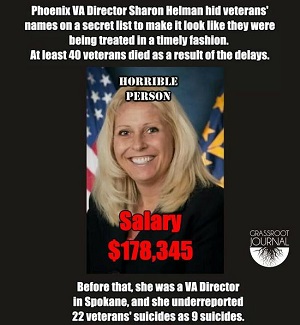
It seems the "secret waiting list" scandal at the VA (Veteran's Administration) hospitals is
growing like a fungus. First reported at the Phoenix VA facility, now it appears the problem is not unique to the Arizona facility.

Similar reports are hitting the news about delays and secret lists from Missouri, Illinois, Wyoming, North Carolina, Texas and Colorado.

Attorney General Eric Holder said
'Well, obviously these reports if they're true are unacceptable, and the allegations are being taken very seriously by the administration,' Holder told reporters on Tuesday.
'But I don't have any announcements at this time with regard to anything that the Justice Department is doing,' he said.

The Attorney General has also failed to investigate reports of voter fraud, the IRS scandal, "fast and furious, or get to the bottom of what really happened in Benghazi.

On the other hand he has taken an active role in the Trayvon Martin shooting, including allowing the DOJ Community Relations Service to support protests by the New Black Panther party at the Zimmerman trial. Following the acquittal of George Zimmerman Holder announced the Justice Department would investigate possible civil rights charges against Zimmerman.

Holder also authorized an investigation of Fox News reporter James Rosen, alleging possible violations involving "national security".
But so far the AG has refused to consider any investigation regarding the VA.
VA hospitals are required to see patients within two weeks to a month of their request for an appointment. Between 1,400 to 1,600 veterans were not logged into the VA's official system in a surreptitious plot to hide the hospital's months long wait times
Reports of possibly 40 deaths at the Phoenix VA are not on Mr. Holder's radar at this time. After all, "What difference, at this point, does it matter?"


Red wine health news

Not that I'd have guessed this, but we've been blogging about the health benefits of the compound resveratrol for years. it can be found in blueberries and even peanut butter, but perhaps its most well-known source is red wine.

And therein may lie a problem:

"A new study published in JAMA Internal Medicine on the health effects of resveratrol – a compound found in red wine, dark chocolate and some fruits and vegetables – has generated a lot of sensational headlines"

This study claims that there are, in fact, "no health benefits from red wine and chocolate."

[ed: one wonders, then, about the anti-oxidant properties of dark chocolate - are these hype, as well?]

Sounds bleak, no?

Never fear, Dr Manny is here (Dr. Manny Alvarez is FOX News Channel's Senior Managing Editor for Health News; he is also a member of numerous professional societies). The good doctor has a number of qualms about the study:

"... there were many factors omitted in the study. We have limited knowledge of the lifestyle and family histories of these participants. Furthermore, surveys carry a certain degree of inaccuracy, because they rely on the honor system. And the researchers did not measure participants’ resveratrol levels at the end of the nine-year study period to see how these levels might have changed"

Seems like that last bit reflects a major fail on the researchers' part.

On the other hand, Dr Manny is also a bit leary of the purported benefits of resveratrol, and cautions us to be skeptical about some of the claims its proponents make:

"Many Americans may believe that taking a daily pill, like resveratrol, can prevent any number of diseases. That is not how diseases work."

So, is resveratrol a hero or a villain? Well, probably not the latter, but maybe not the former, either.

More VA Shenanigans

And to the (growing) list of Colorado, Texas and others, we now add:

"The Veterans Health Administration has placed two Durham [NC] VA Medical Center employees on administrative leave after learning the employees may have "engaged in inappropriate scheduling practices."

"Inappropriate."

Hunh.

And just what does the Veterans' Administration (a government-run health care scheme) characterize as "inappropriate?"

Can't tell you, don't know:

"It was not made immediately clear what sort of scheduling practices the employees may have engaged in."

Here's the thing, though: failing to disclose the nature of the transgressions certainly implies that they are far more egregious than "inappropriate." How badly did these employees screw up that their superiors won't even acknowledge the nature of their (mis)deeds?

Well?

[Hat Tip: HotAir]

The ObamaTax vs The Uninsured

Over the years, we've debunked the myth of the "47 million" uninsured. Nevertheless, there is no doubt that, prior to The ObamaTax, there were, in fact millions - perhaps tens of millions - of folks who had no health insurance (some by choice, some by circumstance). But it has always been the explicit purpose of The ObamaTax to bring the uninsured into the fold.

So how's that working out?

Well, we don't really know how many folks have actually bought (as in: chosen, enrolled in and paid for) a plan, but millions of Americans lost their existing coverage (repeated promises to the contrary notwithstanding):

"... the survey still indicates that three-fourths of enrollees were previously insured ... for all of the talk about 7-million this and 8-million that, the Obamacare exchanges’ expansion of coverage to the uninsured was far smaller."

So if we take the law's proponents at face value, then even by - especially by - their own standards ("47 million uninsured") the result is a miserable, rotting failure.

But then, that's not really "news," is it?

[Hat Tip: FoIB Holly R]

Alphabet Soup News: "Un-Excepted" Benefits

Our friends (and resident FSA/HRA/HSA gurus) FlexBank share some important news for employers that offer Flexible Spending Accounts (FSAs):

Best be careful how you have your plan set up, lest it be deemed "Un-Excepted."

Prior to the ObamaTax, FSA plans weren't terribly complicated or subject to many regs. That's all changed, and employers that get caught unaware of these changes face some significant additional costs.

"Excepted" FSA plans continue to enjoy tax-advantaged status and the various benefits that accrue to both the employer and employee in these arrangements. But plans that "fail the test" will be required to pay the Patient-Centered Outcomes Research Institute (PCOR) fee.

And in case you were wondering:

"The amount of the PCORI fee is equal to the average number of lives covered during the policy year or plan year multiplied by the applicable dollar amount for the year ... For policy and plan years ending after Sept. 30, 2013, and before Oct.1, 2014, the applicable dollar amount is $2."

Now, that may not seem like a lot, but if you have hundreds - or thousands - of employees, that two bucks can add up in a hurry.

But wait, that's not all!

In addition to the PCOR fee, employers whose plans have been ruled as "Un-Excepted" will be on the hook for "unlimited preventive services upon 2014 renewal." This means that, even if there's no actual cash left in an employee's account, the employer will have to pay for unreimbursed preventive care expenses.

Let's say Joe has $1,000 in his FSA, and blows through that by September. If he then has a routine physical in October, and the insurance pays all but $150 of it, the employer is on the hook for that extra $150. Again, that may not seem like a lot, but what if there are hundreds of employees playing that game?

And there's this:

If an employer has an "Un-Excepted" plan and is contributing $500 or more each year to each employee's FSA, then that contribution will now have to be "cashable;" that is, an employee can simply cash it out (he'll be liable for the taxes, natch).

So how does an employer keep on the straight-and-narrow? Well, there are two major criteria for maintaining "Excepted" status:

First, there's a limit on the maximum benefit payable under an FSA plan (this comes into play primarily on those plans where the employer also contributed).

Second - and this one's a doozy - there's the "Availability Condition." The helpful folks at FlexBank explained that there are several components to this condition. First, participation eligibility by class. That is, "so long as all of the employees in a class of participants eligible for the health FSA are also eligible for major medical coverage and the entry dates for both are the same, the Availability Condition will be satisfied.”

For example, Jiffy Widgets offers group insurance only to full-time employees, but opens up its FSA plan for everyone, full- or part-time. That's a no-no. Jiffy could offer group and FSA to only full-timers, but can't mix-and-match.

Then there's the waiting period. Some employers will allow new employees to start up an FSA their first day on the job, but require a 90 day wait to go on the group plan. That's now a no-no.

Finally (well, as far as this post goes), an FSA is considered "Un-Excepted" if the employer doesn't offer group health insurance. So all those employers that are considering deleting their group cover will have to now consider whether their FSA is important, because dropping the group but keeping the FSA means additional costs (which might eat up a substantial portion of the anticipated savings).

Want to know more? Well, our friends at FlexBank have graciously permitted us to link their FAQ, which has more detailed information.

Thanks, FlexBank!

Mandates and Consequences

Years ago, there was a cute advertising campaign with the slogan "It's in there!" The message referred to "homemade taste," and implied various wholesome ingredients.

Unfortunately, a concept that works for marinara doesn't translate well to health insurance, a lesson that seems to have eluded Tar Heel State legislators.

FoIB Jeff M tips us to this development:

"North Carolina insurance policy holders will pick up $10.5 million in additional premium costs if a bill requiring expanded coverage of chiropractic services ... is approved in the General Assembly’s short session opening this week."

We've long noted that mandated benefits drive up the cost of policies, often in ways that aren't immediately obvious. For example, this new chiropractic benefit will increase demand, benefiting chiropractors. But it's also a signal to other providers that they, too, should be clamoring to get on board the gravy train:

"Critics of the health mandate to lower patients’ co-pays for chiropractic services ... say Senate Bill 561 would entice other specialists, such as physical and occupational therapists, to seek similar payment parity. That would shift more costs from individual patients to all insurance consumers"

No kidding.

Now, one could argue that insurance is, after all, about "spreading the risk." And that's true, up to a point. The problem is that not everyone shares the same kinds of risks, and these mandates fail to take into account the disparate impact they'll have on other consumers while inflating premiums ever higher.

Need a lyft? (P&C Tricks Update)

Almost 3 years ago, we posted on the inherent risk problems of car- and ride-sharing services:

"Seeing a business opportunity in millions of cars that sit idle at office parking lots or on weekends, several start-up companies have introduced "peer-to-peer" car-sharing services ... Likewise, renting out your car to someone you've never met (and will probably never even see!) is a dramatic change in the nature of your insurance policy's risk."

Well, the folks in the Cornhusker State are catching up with IB:

"The Nebraska Departments of Insurance and Motor Vehicles are urging caution before people sign up for Internet services that connect drivers, riders and vehicle owners for car-sharing and ride-sharing."

They point out many of the same risks that we noted in '11, but also offer suggestions on how to address them. Here's a few:

• Review carefully any type of agreement involving car-sharing or ride-sharing.

• Before deciding to rely on insurance that is provided by others, that they are sure to get a copy of the policy and ask an insurance professional to make certain it covers all of their exposures.


Read the rest at the link (especially if you're considering this as a way to supplement your income).

[Hat Tip: FoIB Bill M]

Turismo Médico, CoveredCA-style

It's been a while since we last discussed medical tourism. Most of our previous posts on the topic involved residents of other countries traveling to the US for (superior) care.

Unfortunately, the ObamaTax has essentially turned this on its head:

"Californians unhappy with their forced Obamacare related healthcare packages are finding a cheaper and more efficient way to see a doctor — high tail it to Mexico."

In Tijuana, a doc visit goes for about $15, and the standard of care is apparently quite satisfactory.

Olé!

Cavalcade of Risk #208: Call for submissions

Jason Fisher makes his CavRisk hosting debut next week. Entries are due by Monday (the 12th).

To submit your risk-related post, just click here to email it.

You'll need to provide:

■ Your post's url and title
■ Your blog's url and name
■ Your name and email
■ A (brief) summary of the post

PLEASE remember: ONLY posts that relate to risk (not personal finance tips and the like). And please only submit if you are willing to link back to the carnival if your submission is accepted.

Have We Been Deduped?

Like a couple of dueling pianos we have a fight brewing on the percentage of people who have paid health insurance premiums on the exchange. One side says this:

67% of Obamacare enrollees have paid their premiums.

Then the other says this:

Most people - about 80% - are paying their Obamacare premiums.

Media is hysterical over paid enrollments as it is being spewed that paying premiums is the most important part of the success of Obamacare. Guess what - they are wrong.

During today's testimony in the House Energy and Commerce Committee several of the largest insurers in the United States stated that they have seen 80% or more of those who enrolled pay their first premium.

Lost in the noise was a paragraph from Mark Pratt, Senior VP of State Affairs for AHIP. It is this unknown that will drive the success of Obamacare enrollment.

Duplicate enrollments: Because of the challenges that surfaced with the launch of the Exchanges in October 2013, some consumers were advised to create a new account and enroll again. As a result, insurers have many duplicate enrollments in their system for which they never received any payment. In cases where an insurer has a new enrollment for a consumer who previously enrolled, they are not expecting that original policy to be effectuated – even though that data is still reported.
 
Which brings me to this: was the data being shared by these insurance companies today deduplicated? If so, then how many enrollments were there prior to the deduplication process for each insurance company? Answers to these two questions would have shone a bright light on the real enrollment numbers in exchanges.
 
But instead our elected idiots didn't ask. Nor has/will the MSM. Instead they would rather regurgitate figures verbatim without doing any actual research.
 
In both cases it appears that they have been deduped.

Et tu, Texas?

Following on the heels of the news that Colorado VA bureauweenies "were instructed last year how to falsify appointment records so it appeared the small staff of doctors was seeing patients within the agency’s goal of 14 days," we have confirmation that this is much more widespread:

"A Department of Veterans Affairs scheduling clerk has accused VA officials in Austin and San Antonio of manipulating medical appointment data in an attempt to hide long wait times to see doctors and psychiatrists"

In fact, I'd be very surprised if this wasn't happening in all 58 states. And remember: these are the same folks (Federal employees) that are now in charge of your health care.

Other Than That, How Did You Like the Play Mrs. Lincoln?

Mary Todd Lincoln did not have a good night on April 15, 1865. 


U.S. taxpayers did not have a good open season for Obamacare 2014.

Illinois citizens didn't exactly beat down the doors to purchase health insurance designed by politicians, endorsed by their former senator and built in Washington. Over the 6 month period an estimated 217,500 residents purchased Obamacare plans.

Blue Cross crushed the market by capturing 200,000 enrollees . . . about 92% of the market.

Good for them. Bad for the other 5 players. Including one operation that used a wad of Obamabucks to fund their upstart organization.

For instance, one of the insurers, Chicago-based Land of Lincoln Health Inc. Co-op, captured just 2 percent of Illinois enrollments in Obamacare. More than 3,600 individuals, families and small businesses enrolled, Dan Yunker, CEO of Land of Lincoln Health, said in a statement.
Nevertheless, the co-op, which was created with $160 million in federal loans to stir price competition among insurers on the exchange, is filing plans with the Illinois Department of Insurance for the next enrollment period, which begins Nov. 15. And it is looking at how to woo more customers.

Land of Lincoln (LOL) used $160 million to enroll 3,600 members.

In case you don't have a calculator handy, that's over $44,000 per participant.

Not a laughing matter.


Cause and Effect?

Here's a conundrum:

Given Observation A:

"By mid-April, just 10,714 people had signed up for a private ObamaCare plan through the D.C. exchange ... All told, that works out to more than $13,123 per ObamaCare exchange sign-up"

And B:

"Hawaii was even more expensive. Just 8,592 Hawaiians signed up ... That translates into $24,080 per enrollee."

And C:

"All told, the federal government handed out $3.9 billion in grants to 14 states and D.C. to build their exchanges, and another $827 million in grants to states that in the end decided not to build one ...That's an average $1,850 per enrollee in these 15 markets"

 To name a few.

Remember, that's not premium dollars coming in, that's taxpayer funds headed out . And we still don't know how many of these folks have actually paid any premiums, thereby completing the "sale."

So, given all that, here's my question:

How it it, then, that the Palmetto State's insurance director has concluded that "the true number of people actually enrolled is much lower?" That is, what do we really have to show for the billions of taxpayer dollars flushed down the ObamaTax toilet?

The VA Strikes Again

Last week, we reported that "[m]ore than 1.5 million medical orders were canceled by the Department of Veterans Affairs without any guarantee the patients received the treatment or tests they needed"

Turns out, this was far from an isolated incident. Today we learn that

"Clerks at the Department of Veterans Affairs clinic in Fort Collins [Colorado] were instructed last year how to falsify appointment records so it appeared the small staff of doctors was seeing patients within the agency’s goal of 14 days."

So, two questions: How many more of our vets will die because the bureauweenies in charge of this government-run health care scheme must die needlessly?"

And: Aren't these the same type of bureauweenies who are now in charge of civilian health care?

Sleep well....

Top. Men.

Say you're the Vice-President of the United States. And say your boss's "Signature Legislation" was a fundamentally flawed redefinition of your country's health care financing and delivery system. And say you think it's just grand.

Wouldn't you want to hard-sell the citizen of another country to sign up?


[Hat Tip: The Gateway Pundit]

Romneycare Days Numbered?

And in the beginning Romneycare begat Obamacare. But Romneycare's days may be numbered.
RomneyCare’s pioneering health insurance exchange is headed for the scrap heap.
Bay State officials are taking steps this week to junk central parts of their dysfunctional health insurance exchange — the model for President Barack Obama’s health care law — and merge with the federal enrollment site HealthCare.gov.
The decision is part of an expensive plan that would occur alongside a parallel, last-ditch attempt to still build a working state system.

The ObamaTax and the IRS

Were the stakes not so high, this could be funny:

"The investigators charged with keeping tabs on the Internal Revenue Service have no way to tell how well they can detect health insurance premium tax credit fraud."

No kidding

The problem is that the distinction between "fraud" and "honest mistake" is a very thin line as regards the ObamaTax. After all, in applying for a subsidized individual plan through the Marketplace, one is asked to rely on "anticipated" income in an economy that is anything but robust. Some folks have fairly regular, steady incomes, but a lot have spikes, and dry spells (think commissioned sales people, entrepreneurs, etc).

And of course,between the poorly-secured 404Care.gov site and unvetted Navigators, the system itself is fraught with the potential of major fraud on the government's end.

In related developments, the IRS has "given the new public health insurance exchanges rules for reporting on the private health coverage they have sold."

To wit: they've released the long-awaited Form 1095-A, which insurers must use to report - monthly(!) - how many victims customers they've "enrolled." The government will then use this info to bolster the tax credits program (see Fraud above).

Exit question: is it just me, or is it, well, curious that the form doesn't include how many enrollees have actually paid for their new plans?

FUBAR

Should Obamacare be fixed or repealed? 


Depends on who you talk to . . . and who has read the law . . . and who hasn't.
Rep. Cathy McMorris Rodgers (R-Wash.), the No. 4 House Republican, is walking back comments attributed to her that ObamaCare can’t be repealed. But she’s not the only one suggesting Congress merely make changes within the framework of the health law. Senate Minority Leader Mitch McConnell (R-Ky.) says the goal is to get the law “fixed.” It seems many GOP lawmakers still haven’t read the law, or they’d know the framework is corrupt.
NY Post

Corrupt?

Pretty strong words, don'tcha think?

Or just brutal honesty.

8 million have allegedly signed up for Obamacare.

The population is around 315 million. About a third of those are on Medicare or Medicaid. That leaves 200 million+ that could be covered by some form of Obamacare (including employer plans that pass the IRS smell test).

So why can't it be repealed?
Instead of government employees promoting ObamaCare and enrolling the uninsured, the law (Sec. 1311) reserves these jobs for community activists, unions, community health centers and other not-for-profits. Players include the NAACP, Planned Parenthood and Service Employees International Union. Hiring these groups is a way to fund the Democratic Party’s shadow army between elections.
Assisters sign up the uninsured for non-health benefits and register them to vote. The National Association of Community Health Centers identifies voter registration as a key part of its mission.
Sounds like corruption to me.
Or it could just be FUBAR.

MVNHS© and the VA: Twin Sons...?

Consider this:

"The NHS faces such a crisis that it is a question of “when, not if” it runs out of money, a report warns. Health charity the King’s Fund says that with a quarter of trusts already in deficit, a financial meltdown is “inevitable by 2015-’16 and could arrive sooner

This has significant relevance to our own ObamaTax system, since it was touted as "bending the cost curve" (presumably downward) thus reining in ever-increasing health care costs. As we can see from the experience of the Much Vaunted National health System©, such schemes do not, in fact, actually lead to that result.

But we can look closer to home for an even more egregious example. The VA is, in fact, a nationalized health care delivery system, run by government bureauweenies, and is most likely the kind of system proponents of the ObamaTax would like to see implemented for the entire country.

And how well does the VA handle health care?

Well:

"More than 1.5 million medical orders were canceled by the Department of Veterans Affairs without any guarantee the patients received the treatment or tests they needed"

Granted, that is one way to reduce health care costs, but I'm pretty sure that's not what the rest of us actually had in mind.

Warm fuzzies, indeed.